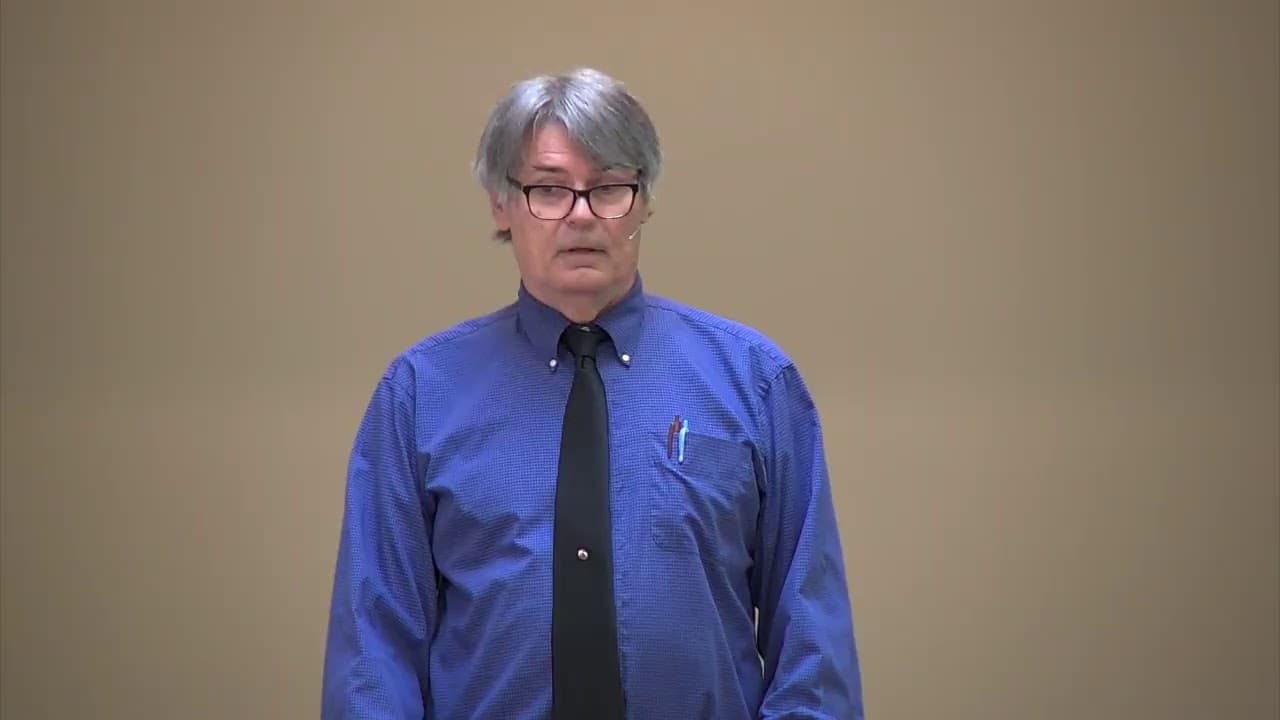
In this message, Jim emphasizes the importance of every believer embracing their calling as priests. He underscores that being a priest is about fostering a special relationship with God and serving Him out of that relationship.
Jim uses three Old Testament examples to illustrate the results of priestly ministry: Jehoiada, who helped crown Joash the rightful king; Hilkiah, who presented the lost Book of Law to King Josiah, leading to revival; and the priests who carried the Ark of the Covenant into the Jordan River, demonstrating God's authority and leading the people forward.
Jim concludes by encouraging believers to embrace their priestly roles by reading and studying the Word, praying, gathering together, serving others, listening to God's voice, and obeying His commands. He reminds everyone that God wants us to be fulfilled in our relationship with Him and serve Him wholeheartedly.
Happy holiday. Maybe it would be a joyous Advent. Maybe that’d be better.
I’d like to read a few verses before we start, beginning with Exodus 8:1.
And the Lord spoke to Moses, “Go to Pharaoh and say to him, ‘Thus says the Lord: Let My people go, that they may serve Me.’”
And then Exodus 19:6. This is the Lord speaking:
“You shall be to Me a kingdom of priests and a holy nation.”
And then 1 Peter 2:9, almost a reiteration there:
But you are a chosen generation, a royal priesthood, a holy nation, His own special people, that you may proclaim the praises of Him Who called you out of darkness into His marvellous light.
And then, showing that I am a true Richmonder, Revelation 1:6. Well, let’s go back to verse 5. The verse says:
To Him Who loved us and washed us from our sins in His own blood, and has made us kings and priests—or, as another version says, “a kingdom of priests”—to His God and Father, to Him be glory and dominion for ever and ever. Amen.
Let’s pray.
Father, I’m grateful, like I said this morning, that we do not have to grieve today, because You have given us a Saviour, Jesus Christ the righteous.
Lord, this morning, we rejoice in Him. We are thankful that You have called us to Yourself through Him, and He has saved us. We do present ourselves to You, Lord, as Yours: to be with You, to give ourselves to You here in speaking and hearing, and to ask, O Lord, that You would be pleased to speak to us this morning.
Father, I admit my own weaknesses, and these brothers and sisters do not need to hear me. I need to hear the voice of God.
Lord, I’m only asking this: that You, by Your Holy Spirit, would take something of this Word, make it Your own, and bring it to Your people, that they might be encouraged and empowered to follow You all their life, Lord. In Jesus’ name.
I really wanted to talk about something else today, but this is what the Lord gave me.
The last couple of times I was able to share with you, we talked about serving God in our generation. You’re going to find out that the Lord has burdened me—it’s the burden of calling people into personal relationship with Him.
I’m sorry, but that’s what He has impressed me with most in my reading of the Scriptures: that we are to go on with Him. You probably will get tired of it, but I think that this is something the Lord really has on His heart.
Almost every time I talk, you hear something of that. I’m not saying that as an apology, because I think that’s on the Lord’s heart. I’m just saying that’s the way it is. This is what the Lord has given me.
As we have been talking about how we are to serve God in our generation, we talked about it being a relationship. But I want to go further than that this morning, so that we don’t think we are just going off on our own and having our own little relationship.
We are all called into a relationship that brings us into a body. In this relationship, in this body, we are brought into a relationship to serve God.
That is what He redeemed Israel for. When He redeemed Israel, He said, “Let them go out and serve Me on this mountain.” In the same way, He doesn’t save us just to say, “Go away, children. Have fun.” He calls us to Himself, that we may serve Him.
You probably noticed from these verses that I read that they all have to do with the priesthood.
Being a former Catholic, you might think that I have a different view of priesthood. They have priests in every religion. But one of the things that made the Reformation really important—one of the teachings that came out of the Reformation—was the priesthood of every believer.
There are groups such as the group that we are around, and the group that I come from, that have a tendency, because we are all called to be priests, to let only certain people function as priests. The rest of us put it on autopilot and let it go.
That’s not what the Lord is after. The Lord is after everyone being a priest.
Now, what is a priest? I want to make it very, very simple.
It’s not somebody who wears a robe. It’s not someone who officiates the Eucharist. In very simple terms, a priest is a person who has a special relationship with God. Out of this special relationship, he is able to serve God.
That’s what a priest is: someone who has a special relationship with God, and out of that relationship offers service to his God.
It doesn’t make them people who are holier than thou. It makes them real.
I can only speak from my own experience. As I said, I grew up Catholic. I remember Father Wallace. Father Wallace was a younger priest, and I remember that he played football with us.
He was not off somewhere in the heavenly realm or something like that. He took who he was and the ministry that he had from God, and he brought it down to us. I thought that was really neat. That was impressive. It made an impression on me.
At the same time, he served God. In doing that, he served God.
This is your faith as a Christian. This is your faith. This is your purpose in being a Christian. This is your vocation as a Christian.
All who are in Christ have been called to be priests: to have this special relationship and, out of this relationship, to serve our God.
I’m not going to go into what a priest does and such like that. Maybe at some other time. But I want to look at the result of priestly ministry.
You have to take these things both personally and corporately. You can’t say, “This is for the personal, and this is for the corporate,” because they apply to both.
What are the results of this priestly ministry? We want to see the importance of it for us, for God, and for His purpose in the church.
We are going to look at three examples, or three results, of priestly ministry. They are all in the Old Testament, because that is mostly where we see priests.
The priests we see generally, except for the epistles, are not always good examples in the New Testament. They are the ones, like the one who passed by the man who was wounded while the Samaritan took care of him—not a good example.
So we want to look at some good examples.
We are going to go back to 2 Chronicles. I know this is the book that most of you read the most.
I will say this: if you read 1 Chronicles, 1 Chronicles is the book of grace. In 2 Chronicles, you have the falling of the kingdom. First Chronicles is so full of grace.
So we are going to look at 2 Chronicles, beginning in chapter 22 with verse 10.
Now when Athaliah the mother of Ahaziah saw that her son was dead, she arose and destroyed all the royal heirs of the house of Judah.
But Jehoshabeath, the daughter of the king, took Joash the son of Ahaziah, and stole him away from among the king’s sons who were being murdered, and put him and his nurse in a bedroom.
So Jehoshabeath, the daughter of King Jehoram, the wife of Jehoiada the priest—for she was the sister of Ahaziah—hid him from Athaliah, so that she did not kill him.
And he was hidden with them in the house of God for six years, while Athaliah reigned over the land.
In the seventh year, Jehoiada strengthened himself and made a covenant with the captains of hundreds: Azariah the son of Jehoram, Ishmael the son of Jehohanan, Azariah the son of Obed, Maaseiah the son of Adaiah, and Elishaphat the son of Zichri.
They went throughout Judah and gathered the Levites from all the cities of Judah and the chief fathers of Israel, and they came to Jerusalem. Then all the assembly made a covenant with the king in the house of God.
He said to them, “Behold, the king’s son shall reign, as the Lord has said of the sons of David.”
So the Levites and all Judah did according to all that Jehoiada the priest commanded. Each man took his men who were to be on duty on the Sabbath, and those who were going off duty on the Sabbath, for Jehoiada the priest had not dismissed the divisions.
And Jehoiada the priest gave to the captains of hundreds the spears and the large and small shields which had belonged to King David, that were in the temple of God.
And he set all the people, every man with his weapon in his hand, from the right side of the temple to the left side of the temple, along by the altar and by the temple, all around the king.
And they brought out the king’s son, and they put the crown on him and gave him the Testimony and made him king. Then Jehoiada and his sons anointed him and said, “Long live the king!”
And when Athaliah heard it, she came to the people in the house of the Lord. They killed her.
Now, Jehoiada was the high priest at the time, and he served as a priest. But what came out of the ministry of this priest? What came out of the ministry that he had to Judah at this time, and to the Lord at this time?
The result of his ministry was that the king was put on the throne. The king was put in front of Israel.
That’s an important thing, because one of the ministries of priests is to bring the King to His throne.
When David was crowned king in Hebron, Hebron was a city of priests. That’s where he was crowned first—in Hebron.
The same is true here. It is priestly ministry that brings the King to His throne in the assembly and in your own life.
Here, somebody had usurped the throne. The throne had been taken away from its rightful owner, from the One Who should be on the throne.
The priests were the ones who took the rightful king and placed him back on the throne. That was the result of their ministry.
Up to this time, there had been something like fifteen or sixteen years in which there had either been a king who followed the ways of Ahab—or the kings before Joash had been related or married into Ahab’s family, and what was in Ahab’s family had leaked into Judah.
Then you had this one who actually usurped the throne and said, “I will rule in his place,” and murdered the others.
This priest hid the rightful king at peril to his own life. Then, at the right time, he brought him forth and brought him to the brothers and sisters and said, “This is the king. He should be on the throne.”
Those brothers and sisters agreed. “Yes, he’s the one who should be there.”
The other part of this priestly ministry was that he equipped these people to put the king on the throne.
It says that Jehoiada the priest gave the captains of the hundreds the spears and the large and small shields which had belonged to King David. He took the royal weapons and said, “Here they are. Now you’re equipped to put the king on the throne.”
That is priestly ministry. Priestly ministry equips. So the result of this was that the people were equipped, and the king was put on the throne.
Now let’s look at another example. Stay in 2 Chronicles, where they have all these wonderful names.
I think some of us should be glad we weren’t born in biblical times.
Let’s go to 2 Chronicles 34. We’ll start with verse 14.
What had happened, to give you a preview, was that this was during the reign of Josiah. Josiah had sent the priests to repair the temple, and he gave them money. He said, “I want you to repair the house, the temple.”
They were going about repairing things.
Now when they brought out the money that was brought into the house of the Lord, Hilkiah the priest found the Book of the Law of the Lord given by Moses.
Then Hilkiah answered and said to Shaphan the scribe, “I have found the Book of the Law in the house of the Lord.” And Hilkiah gave the book to Shaphan.
So Shaphan carried the book to the king, bringing the king word, saying, “All that was committed to your servants, they are doing. And they have gathered the money that was found in the house of the Lord and have delivered it into the hand of the overseers and the workmen.”
Then Shaphan the scribe told the king, saying, “Hilkiah the priest has given me a book.” And Shaphan read it before the king.
Now the king responded to this. Let’s look at his response, beginning in verse 29.
Then the king sent and gathered all the elders of Judah and Jerusalem. The king went up to the house of the Lord with all the men of Judah, and all the inhabitants of Jerusalem, the priests and the Levites, and all the people, great and small.
And he read in their hearing all the words of the Book of the Covenant which had been found in the house of the Lord.
Then the king stood in his place and made a covenant before the Lord, to follow the Lord and to keep His commandments and His testimonies and His statutes with all his heart and all his soul, to perform the words of the covenant that were written in this book.
And he made all who were present in Jerusalem and Benjamin take a stand. So the inhabitants of Jerusalem did according to the covenant of God, the God of their fathers.
Thus Josiah removed all the abominations from all the country that belonged to the children of Israel, and made all who were present in Israel diligently serve the Lord their God. All his days they did not depart from following the Lord, God of their fathers.
If you wanted to go back, I think it’s in 2 Kings 23, where it goes step by step through the actual things that he did.
But let’s look at the ministry of the priest here. The ministry of the priest was this: he took the Word of God and brought it to the king.
Remember, we just talked about putting the king on the throne. Now this priest took the Word of God to the king, and then the king took the Word of God and put authority in it.
Out of that authority, there was revival. Revival came to the people of Judah because the Word of God had been given by the king, and the Word of God had been taken to the king by the priest.
What am I trying to say here? I’m saying this: priests take the Word. When they hear it, when they read it, they don’t trust their own understanding with it. They take it to the King and say, “What are we to do with this?”
Hilkiah didn’t go to Josiah and say, “You’ve got the law. Here it is. You’d better straighten out society. My interpretation of this is that you need to do this, this, and this.” He didn’t do that.
He took it to Josiah himself and said, “How do you see this? How do you read this?”
Josiah tore his clothes. He looked at it and said, “This is bad news.” But the good news was that he responded to what he saw. He saw things that were wrong, and he took them and made them right.
It is the same thing with us. The priests take the Word to God. God gives the interpretation, and then God sets things in order, reviving them.
When we talk about revival, I don’t know what kind of pictures you get in your mind. Maybe people hanging on lampshades, swinging, speaking in tongues, and things like that. That could happen. There’s nothing wrong with that. That’s from God.
But what revival does mean is that life is breathed in.
If you’re dead—you drown or something like that—you can be revived. How do you get revived? They clear out what is in you, and then they breathe life into you.
That is what happened in Josiah’s time. Through the Word that came, he said, “Hey, things are wrong.” He started on the inside. He looked at the things they had in the temple and said, “These things don’t belong here. Let’s get them out of here.”
When he got the inside cleaned out, he started looking around and said, “These things are around the land. These things are wrong too. We have to get rid of these.”
It went all the way outside, so the whole land of Judah came under this.
Then he celebrated Passover. The Word brought him right back into the gathering of all the people together. That’s what Passover was, right? Everybody was supposed to come to Passover.
He sent word to everybody, even to the people in Israel who had been taken away as captives. If he could find anyone, he brought them in and said, “Let’s celebrate the Lord’s Passover.”
The ministry of the priest was to have the Word, take it to the Lord, and then let the Lord put authority behind the Word and bring about what He wanted to do, which was give life to His people.
Let’s look at one other example. That’s in Joshua 3.
We’ll begin with verse 1.
And Joshua rose early in the morning, and they set out from the Acacia Grove and came to the Jordan, he and all the children of Israel, and lodged there before they crossed over.
So it was, after three days, that the officers went through the camp; and they commanded the people, saying, “When you see the ark of the covenant of the Lord your God, and the priests, the Levites, bearing it, then you shall set out from your place and go after it.
Yet there shall be a space between you and it, about two thousand cubits by measure. Do not come near it, that you may know the way by which you must go, for you have not passed this way before.”
And Joshua said to the people, “Sanctify yourselves, for tomorrow the Lord will do wonders among you.”
And Joshua spoke to the priests, saying, “Take up the ark of the covenant and cross over before the people.” So they took up the ark of the covenant and went before the people.
Then the Lord said to Joshua, “This day I will begin to exalt you in the sight of all Israel, that they may know that, as I was with Moses, so I will be with you. You shall command the priests who bear the ark of the covenant, saying, ‘When you have come to the edge of the water of the Jordan, you shall stand in the Jordan.’”
Now verse 14:
So it was, when the people set out from their camp to cross over the Jordan, with the priests bearing the ark of the covenant before the people, and as those who bore the ark came to the Jordan, and the feet of the priests who bore the ark dipped in the edge of the water—for the Jordan overflows all its banks during the whole time of harvest—
that the waters which came down from upstream stood still and rose in a heap very far away at Adam, the city that is beside Zaretan. So the waters went down into the Sea of the Arabah, the Salt Sea, and were cut off; and the people crossed over opposite Jericho.
Then the priests who bore the ark of the covenant of the Lord stood firm on dry ground in the midst of the Jordan; and all Israel crossed over on dry ground until all the people had crossed completely over the Jordan.
The priestly ministry here was to carry the ark and go ahead of the rest of the congregation.
I don’t want you to get the idea that there are some people who are meant to do this, as though there is some official class of believers today. No, man, we’re free.
But just to show you the ministry of the priest: they were to carry the ark.
The ark is sometimes called the Ark of the Covenant, but I want to look at it as the ark of the testimony, because we hear the word “testimony”.
As a group here, sometimes I think we hear things and just say, “Okay,” without thinking about what they mean.
When John was on the Isle of Patmos, he said:
I was on the island that is called Patmos for the word of God and for the testimony of Jesus Christ.
What does he mean by “the testimony of Jesus”?
In 1 Timothy 6:13, it says that Jesus, before Pontius Pilate, made the good confession, or testimony. He gave witness to the good confession.
If you look at the references, including John 18:36–37, you see what Jesus testified before Pilate:
Jesus answered, “My kingdom is not of this world. If My kingdom were of this world, My servants would fight, so that I should not be delivered to the Jews; but now My kingdom is not from here.”
Pilate therefore said to Him, “Are You a king then?”
Jesus answered, “You say rightly that I am a king.”
I believe the testimony that John carried on the Isle of Patmos was that Jesus was King.
That was a crime, because by saying that, you were saying there was a kingdom greater than Rome.
The testimony of Jesus is what Ernie was talking about last week: it is the kingdom of God within you. It is the government of God in you.
You are saying that there is another King, and you do His bidding. That is the testimony that put John on Patmos, because he could not go the way of the king of the world. He was no longer in that king’s realm. He owed allegiance to another King.
The priests carried this testimony. What is the testimony? The testimony that the Lord was King in their lives.
That is the bottom line of it. This was the testimony that they carried before Him, and they responded to everything as He wished them to do.
In carrying the testimony, you can see when someone carries the testimony.
I’m going to tell you something: it is not a burdensome thing to carry the testimony. Even though these priests had to carry the ark on their shoulders, we carry the testimony in our hearts.
The testimony that we are to carry is that we are yoked with Him. By Him we say, “My Lord is wise.”
People can see that, and they can recognise it. Those who carry the ark, or carry that testimony, are followed.
People will follow that because they see something in it. They see an authority in it.
When those priests came to the water, they weren’t magical men. The passage doesn’t even give us the names of the priests who carried the ark into the water.
They were ordinary people, but they went with the authority of God. When they stepped into the water, you saw the authority of God at work. The water simply piled up, and everyone else went through.
Priests, in some way, are forerunners. I’m not going to say “overcomers”, because “overcomers” has become a buzzword.
Even “forerunners” is difficult, because you think they are out in front of the crowd. But, in a sense, it is true. Somebody has to take up that ministry so that other people will see it and say, “Yes, let’s go that way.”
These priests are the ones who say, “We’ll hold it—not you. Stay back.”
Or perhaps, “You want to hold it too? Come on. Let’s hold it together.” That is what the Lord is after.
In the Old Testament there was a set group of priests, but in the New Testament, in the times we are living in today, we can all carry the ark. We are all made to do that. We are all provided for it, so we can do that.
They go ahead, others see it, and they say, “We’ll go through.” It brings them to the place where God wants them to be.
Why am I saying all this?
I’m saying this because, first of all, I believe—and I’m not being critical; please don’t think I’m being critical, because I’m not—that when the Lord has begun to shake something here, He is trying to do something.
You are in Richmond, to be very personal. He is trying to do something.
He is not shaking it like a child shakes one of those little Christmas balls to see the snowflakes. He is shaking it to shake some things off, but I think, in another way, He is saying, “Wake up.”
Some of us have things going on autopilot. We have lost some people who were of priestly stature, but it is not for us to bemoan those things.
When God allows something to happen, He always has good in mind when He allows it.
What can be the good that He has in mind? He wants priests. He wants us to be functioning in our priesthood.
We are all supposed to be priests.
You might ask yourself, “How can I be a priest?” I told you earlier: it is God’s will. That is one way.
Let’s look at something as we begin to end. Let’s go to 1 Samuel 1.
I know Samuel wasn’t a priest. He was a Levite, but not of the priestly family. He was not one of Aaron’s sons. But the things we talk about here are principles for priesthood.
What does being a priest have to do with me? Let’s look at 1 Samuel 1:10–11.
You know the story. Elkanah had two wives, Peninnah and Hannah. Peninnah had children, and Hannah was barren. Whenever they went to the Lord to pay their vows, Hannah was grieved.
She was in bitterness of soul, and prayed to the Lord and wept in anguish.
Then she made a vow and said, “O Lord of hosts, if You will indeed look on the affliction of Your maidservant and remember me, and not forget Your maidservant, but will give Your maidservant a male child, then I will give him to the Lord all the days of his life. And no razor shall come upon his head.”
Life was given to you for this purpose: for being a priest. That is why God gave you life.
That is why you were saved: so that you could be a priest unto God.
It is His purpose for you. That is the importance of it.
What does having a priesthood have to do with me? That is why God gave you life. He wants you to be a priest. He wants to see that life He has given you before Him.
Notice that a transaction was made here. She said, “If You give me the life, O God, I’ll give it back to You.”
God heard her, because if you read the rest of the chapter, her countenance changes. She knew that she had been heard by God, and she could go out from there.
When she went to give the life back, Elkanah, her husband, said, “No, you don’t have to do this, Hannah. Pray about it and make sure.”
How hard it must have been to do that. Samuel was being weaned, and we don’t know how long that was. In biblical traditions, sometimes they would wean for five years, so Samuel might have been five years old when he was given.
As life was given to us by God for this purpose, we also need to understand that we were given back to God for this purpose.
You might say, “What do you mean, we were given back to God?” What do you think Jesus has done?
It is not just that He died and rose again. In rising again, He brought us all to God and said, “Here they are.”
This was the joy that was set before Him, so that He could endure the shame of the cross: presenting us to His Father to be priests.
That was the joy set before Him. “If I do this, Father, You mean Billy, Your brother? I’ll do it, because I know it brings You joy—and bringing You joy is going to make me happy.”
We were given back to God for that purpose: to be priests and to function in that capacity.
How do I work out the work of a priest? What prepares me?
In 1 Samuel 3:1, it says:
Now the boy Samuel ministered to the Lord before Eli.
What prepares me to be a priest? You do what has been given to you. It is just that simple.
You do what has been given to you.
I don’t know what a five-year-old could do as a priest, but you know what your children did when they were five years old for you. You might have sent them to do this or that, and they did it.
Samuel, to begin with, was a “gofer”—go for this, go for that, go for the other thing. He did the things he was supposed to do. That is what prepared him to be a priest: simply doing what he was given to do.
What are some of the things we are given to do?
We need to read the Word. We need to study the Word. That is something we can do. That is something we are given to do.
This is all simple. I’m helping you. It is simple. It is not a complicated matter.
Sometimes we think that God is like Einstein, and He is going to give us a complicated mathematics problem. We think we are going to look at it and say, “I got a D in algebra.”
We think that God is like that. How wrong we are.
If you ask for a fish, will your Father give you a stone? If you ask for bread, will He give you a stone? Do you think God is going to ask a child to do a man’s work?
I don’t think so. I don’t think God works like that. I think He nurtures us and brings us to a place of responsibility where He can put more on us, but He starts out small.
Read the Word. Pray. You need to pray.
Pray for yourself. Ask the Lord, “Make me aware of the things You want me to pray for. What needs to be prayed for? How can I pray? What should I pray for?”
That is something I always get in my prayer life: “What do I pray now?” You go through things, and sometimes you just need to sit and wait and say, “Lord, show me. Put something on my heart.”
And He will. Then you pray for it.
Do not forsake gathering together. Priests aren’t lone rangers. Priests are together.
You may say, “I have to go home.” Well, then you are a priest to your family. Your priesthood goes everywhere with you.
I heard about some people who came here and made hot cider and hot chocolate for us. They did what they were given to do. Those things are training for being a priest.
The last thing for training for being a priest is found in 1 Samuel 3:4.
The Lord called Samuel, and he answered, “Here I am.”
You know the story. Samuel kept going to Eli.
“What do you want?”
“I did not call you. Go back to bed.”
The Lord called Samuel again, the third time. Samuel rose and went to Eli and said, “Here I am, for you did call me.”
Then Eli perceived that the Lord had called the boy.
Therefore Eli said to Samuel, “Go, lie down; and it shall be, if He calls you, that you must say, ‘Speak, Lord, for Your servant hears.’”
So Samuel went and lay down in his place.
Now the Lord came and stood and called as at other times, “Samuel! Samuel!”
And Samuel answered, “Speak, for Your servant hears.”
We need to have an open ear.
When Jesus our Lord walked around the earth, He said many things. But whenever He said something important, He had a little tag at the end. Do you know what that was?
He who has an ear, let him hear.
I thought we all had ears. Don’t we? He says that some of us hear, but we don’t listen.
We hear a lot of ministry, and we judge it: “That was good ministry. That was the best. Oh, that would send you to sleep. Let’s not have that man up again.”
The whole thing is that it is ministry. Ministry can be stored and brought out later; you can check it out again. But when the Lord speaks, you have to do something.
When the Lord speaks to you, He is not saying, “Let’s discuss this. Why don’t you discuss this with your neighbours? Have coffee over it and talk about what you think.”
The Lord is a King. If the Lord speaks something to you, He is looking for you to do something. He is looking for you to respond.
That is what He speaks for. He doesn’t speak to hear Himself. He speaks to say, “This is what needs to be done. Do this,” as He commands a servant.
We have to have an open ear. May God open our ears.
We also need to obey what He speaks to us.
I know someone may say, “We’re saved by grace, brother.” I’m not talking about being saved from damnation. I’m talking about being a priest. I’m talking about having my soul saved.
When I hear Him and He speaks to me, I need to obey. I need to obey quickly.
You see this with children. I find this with my children especially:
“Will you come here and empty the dishwasher?”
“Just a minute.”
Ten minutes later: “I thought I told you to empty the dishwasher.”
Then I wind up emptying the dishwasher, and I get mad.
Brothers and sisters, when the Lord speaks to us, “Just a minute” isn’t an option.
He speaks for the moment. He speaks to the moment.
Maybe you won’t do something in that moment, but when you answer at that moment, things will be set in motion so that what He wants to accomplish further down the line will be done.
That is what He is looking for. Priests are servants. Servants were bought to serve. We have been bought to serve. That is our function here.
When the Lord touches something—or, in our case, shakes something—it cannot remain the same.
Think about that. It cannot remain the same.
Do you remember when you were first saved, when the Lord touched your heart? Did you remain the same for very long?
No. When the Lord touches something, it cannot stay the same. He has a change for it.
We must adjust or adapt to what is yet to be, because we are going to be what we are going to be.
Brothers and sisters, we are called to be priests. We cannot be the same anymore.
If you hear that call, you have to respond.
Our Heavenly Father, how I thank You that in Your presence You want us to be Your priests.
You want us to have a special relationship with You, and You want our service. Lord, how wonderful that is.
I pray, Lord, that You would take away the ideas we may have that serving You is a heavy thing, too burdensome or too much for us.
Lord, help us to see that You call us to take Your yoke upon us, that Your yoke is easy and Your burden is light, and we will find rest.
Father, more than that, it is not just rest that we are looking for. We are looking for fulfilment in our hearts.
Lord, the only way we will be fulfilled is by being in this relationship with You. This is what You made us for. This is the very thing You have made us for. This is the very thing You have redeemed us for.
O God, we want what You want from us.
Help us, I pray, and bring about what You are doing here.
Lord, if things are not going to be the same, help us rise up. Help us rise up to be what we are to be, that we may go on as a people together.
We are asking this in Jesus’ name.
5 And from Jesus Christ, who is the faithful witness, and the first begotten of the dead, and the prince of the kings of the earth. Unto him that loved us, and washed us from our sins in his own blood, 6 And hath made us kings and priests unto God and his Father; to him be glory and dominion for ever and ever. Amen.
9 But ye are a chosen generation, a royal priesthood, an holy nation, a peculiar people; that ye should shew forth the praises of him who hath called you out of darkness into his marvellous light:
6 And ye shall be unto me a kingdom of priests, and an holy nation. These are the words which thou shalt speak unto the children of Israel.
1 And the LORD spake unto Moses, Go unto Pharaoh, and say unto him, Thus saith the LORD, Let my people go, that they may serve me.